How damage and defense work
This guide gives the real rules, in plain words first. Each section has the rule and then a worked example. The examples are computed from the server's own settings, so they stay true when the server changes. See also Monster levels explained for how dangerous each monster is.
One hit, step by step
Every hit in the game goes through these seven steps, in this order. The sections below take them one at a time.
Attack damage from your stats
Your attack damage is a range, for example 147-206. The character window (C) shows it. Each hit picks a number inside the range, and then a weapon adds its own damage on top.
| Class | Lowest damage | Highest damage |
|---|---|---|
| Dark Knight | Strength / 6 | Strength / 4 |
| Dark Wizard | Strength / 8 | Strength / 4 |
| Fairy Elf with a bow | Agility / 7 + Strength / 14 | Agility / 4 + Strength / 8 |
| Fairy Elf without a bow | (Strength + Agility) / 7 | (Strength + Agility) / 4 |
| Magic Gladiator | Strength / 6 + Energy / 12 | Strength / 4 + Energy / 8 |
| Dark Lord | Strength / 7 + Energy / 14 | Strength / 5 + Energy / 10 |
The server drops fractions. A weapon adds its damage, shown on its page, and each +level adds more.
Two weapons. A knight or a gladiator with a weapon in each hand swings both at once, and each weapon's damage counts in every hit. Moo Classic: a gladiator can also hold a staff in his second hand, and it counts for both his swings and his spells.
Two-handed weapons add their damage like any other weapon. Seasons 0 to 2 have no extra bonus for holding one.
Wizardry damage
A wizard's or gladiator's spells use wizardry damage, from Energy:
- lowest: Energy / 9
- highest: Energy / 4
Each spell adds its own damage, from its listed value up to half as much again. Then the staff's rise multiplies everything. A staff with 29 % rise makes every spell hit 1.29 times as hard.
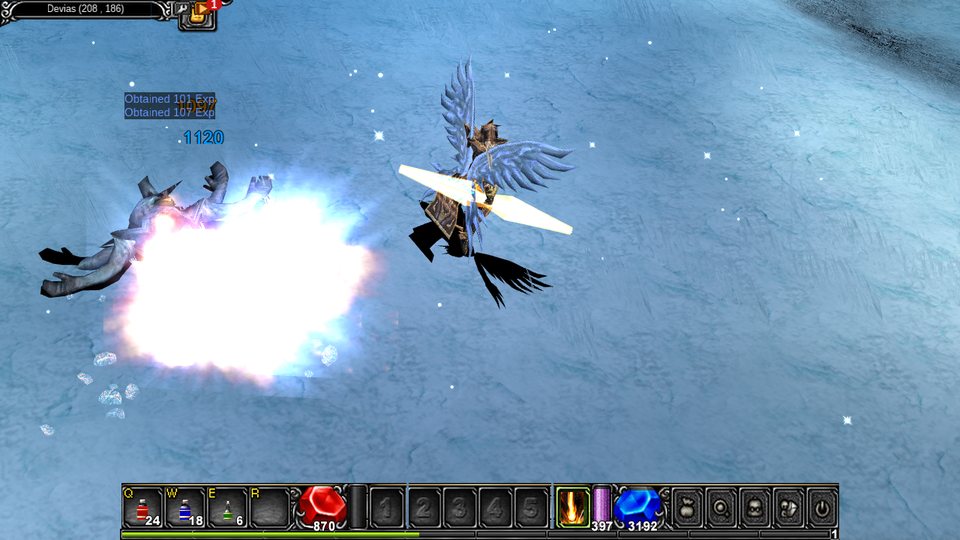
Items with "Additional wizardry damage" add to both ends of the wizardry range before the staff multiplies it. We measured this on a test Soul Master: all 102 of his normal spell hits landed inside the range the rule gives.
Moo Classic: Evil Spirit catches a wider ring of monsters around you than the original's spirits do, and each monster in it takes one hit per cast.
Skill damage
Knight skills (Twisting Slash, Death Stab, Rageful Blow and the rest) work in two parts:
- Your attack damage plus the skill's own damage makes a range.
- After defense comes off, the result is multiplied by 2 + Energy / 1000.
A Dark Lord's skills are multiplied by 2 + Energy / 2000.
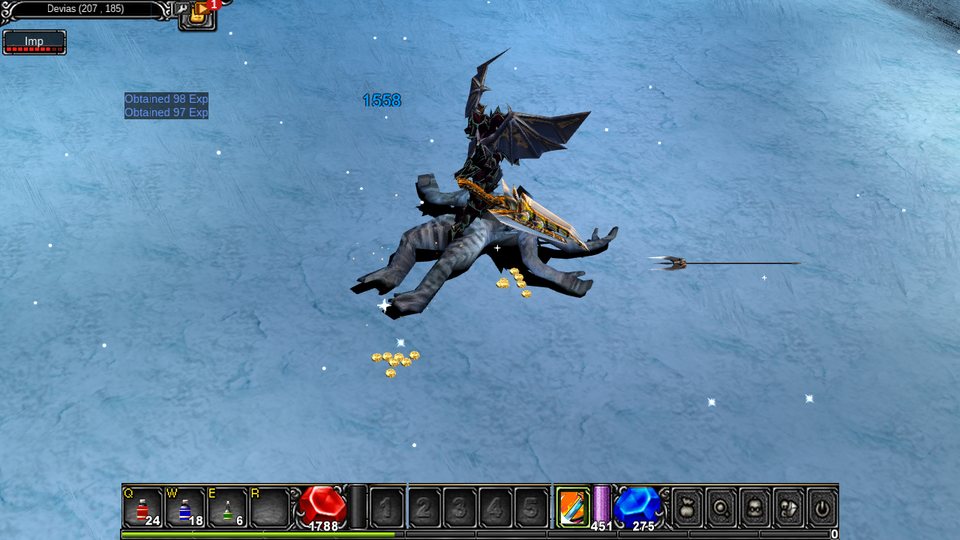
Spells work as in the wizardry section above. The spell's own damage joins your wizardry damage before the staff multiplies them.
Defense, and the damage floor
A target's defense comes off every hit. If what is left is very low, the hit still does a minimum: your level / 10 (at least 1).
Your own defense comes from Agility and your armour.
| Class | Defense from Agility |
|---|---|
| Dark Knight | Agility / 3 |
| Dark Wizard | Agility / 4 |
| Magic Gladiator | Agility / 5 |
| Dark Lord | Agility / 7 |
| Fairy Elf | Agility / 10 |
Every piece of armour, the shield and the wings add their defense, which also rises with each +level.
In the original game, half of your defense comes off each hit you take. Moo Classic: your defense stops more of every hit than in the original. The character window shows your whole defense.
Hit or miss
Before any damage, the game checks if the hit lands. Your attack rate fights the target's defense rate:
- chance to hit = 1 - defense rate / attack rate
- never less than 3 %
| Class | Attack rate against monsters | Defense rate |
|---|---|---|
| Dark Knight, Dark Wizard, Magic Gladiator | 5 x level + 1.5 x Agility + Strength / 4 | Agility / 3 |
| Fairy Elf | 5 x level + 1.5 x Agility + Strength / 4 | Agility / 4 |
| Dark Lord | 5 x level + 2.5 x Agility + Strength / 6 + Command / 10 | Agility / 7 |
A shield adds its own defense rate.
Out-ranked. If a monster's defense rate is higher than your attack rate, your hits on it also deal only 30 % of their damage. This works the other way too: a monster whose attack rate is below your defense rate hits you for 30 %.
Between players, a separate PvP attack rate and defense rate decide hits. Level counts more there and Agility less.
Critical, excellent and ignore-defense hits
Some hits skip the random roll:
| Hit | What happens | Where the chance comes from |
|---|---|---|
| Critical | Your highest damage, every time | Luck on a weapon: 5 % |
| Excellent | 1.2 x your highest damage | The excellent option "Excellent damage rate +10 %" |
| Ignore defense | The target's defense counts as 0 | Second wings and the Cape of Lord: 3 % |
Defense still comes off a critical or excellent hit, unless it also ignores defense.
Excellent spells: an excellent spell hit is 1.2 x the spell's highest damage, less defense. The Soul Master's excellent Evil Spirit on a Balrog deals 104.
Double damage hits come from items of later seasons. No Season 0 to 2 item gives them.
Wings, the Imp, the Angel and the Dinorant
These multiply the damage that is left after defense.
| Item | Your hits | Hits you take |
|---|---|---|
| First wings (Elf, Heaven, Satan) | +12 %, +2 % each +level | -12 %, -2 % each +level |
| Second wings | +32 %, +1 % each +level | -25 %, -2 % each +level |
| Cape of Lord | +20 %, +2 % each +level | -10 %, -2 % each +level |
| Imp | +30 % | - |
| Guardian Angel | - | -20 % (and +50 health) |
| Horn of Dinorant | +15 %, and plain swings x 1.3 on top | -10 % |
Buffs from an Elf
The Elf's Greater Damage and Greater Defense add a fixed amount. Greater Damage joins your hit after the target's defense comes off, and Greater Defense joins your defense.
- Greater Damage: 3 + the Elf's Energy / 7
- Greater Defense: 2 + the Elf's Energy / 8
Players against players
Damage between players follows the same steps. Only two things differ:
- Hit or miss uses the PvP attack and defense rates.
- Defense: works the same as against monsters. Moo Classic: player hits land softer than in the original.
In Chaos Castle damage between players is halved. In a duel, every hit deals 60 %.
How pets wear down
A pet loses durability on every hit that damages you, in proportion to the damage you actually took. A hit you take no damage from costs the pet nothing.
| Pet | Durability lost per 100 damage taken |
|---|---|
| Guardian Angel | 3 |
| Imp | 2 |
| Horn of Uniria | 1 |
| Horn of Dinorant | 0.5 |
A pet starts with 255 durability and breaks at 0.
Moo Classic: the Guardian Angel lasts about twice as long as in the original.
Until the next server update, pets on our server wear down faster than this table says.