Attack rate and defense rate
Guide
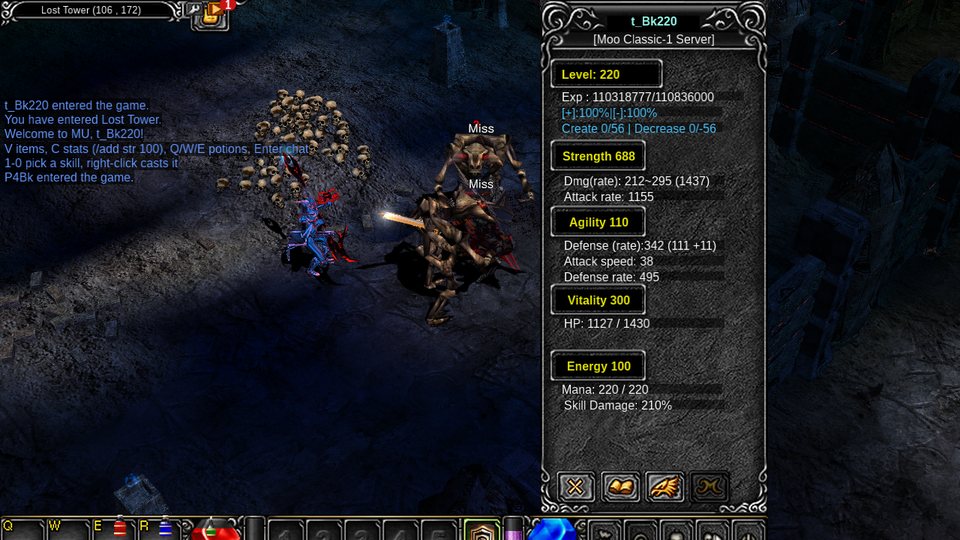
In short: before any damage, the game checks whether a hit lands. Your attack rate against the target's defense rate decides it: the higher your attack rate is over their defense rate, the fewer misses. Against monsters and against players the game uses two different pairs of numbers.
Contents
How a hit lands
1Your attack rate2Their defense rate3The share their rate takes off is your miss chance4Always at least 3 % to hit
- Your chance to hit is 1 - their defense rate / your attack rate.
- If their defense rate is as high as your attack rate or higher, you still hit 3 % of the time.
- The same rule works the other way round, for a monster's or player's hits on you.
- A "Miss" over the target's head means the check failed and no damage was rolled.
Example: a level 150 Blade Knight has an attack rate of 1,105. A Kentauros has a defense rate of 220, so the knight hits 80 % of his swings. A Balrog, with 99, is hit 91 % of the time.
Out-ranked monsters
The rate also changes damage. If a monster's defense rate is higher than your attack rate, your hits that do land deal only 30 % of their damage.
| Who out-ranks whom | What happens |
|---|---|
| The monster's defense rate is above your attack rate | You hit 3 % of the time, for 30 % damage |
| Your defense rate is above the monster's attack rate | It hits you 3 % of the time, for 30 % damage |
This is why a monster far above your level feels like a wall. See Monster levels explained.
Where your attack rate comes from
Against monsters, the attack rate grows with your level, your Agility and a little with Strength. The Dark Lord also gets some from Command.
| Class | Per level | Per 100 Agility | Per 100 Strength | Per 100 Command |
|---|---|---|---|---|
| Dark Knight, Dark Wizard, Fairy Elf, Magic Gladiator | +5 | +150 | +25 | - |
| Dark Lord | +5 | +250 | +16 | +10 |
Against monsters, your defense rate comes from Agility alone, and a shield adds its own.
| Class | Defense rate per 100 Agility |
|---|---|
| Dark Knight, Dark Wizard, Magic Gladiator | +33 |
| Fairy Elf | +25 |
| Dark Lord | +14 |
Example: a Kentauros has an attack rate of 645. Against the knight's defense rate of 56 it lands 91 % of its blows. Agility helps a little here. Armour, wings and life do the real work against monsters.
Players against players
Between players the game uses the second pair of numbers in the window. Level counts more and Strength not at all.
| Class | Attack rate (players) per level | Per 100 Agility | Defense rate (players) per level | Per 100 Agility |
|---|---|---|---|---|
| Dark Knight | +3 | +450 | +2 | +50 |
| Dark Wizard | +3 | +400 | +2 | +25 |
| Dark Lord | +3 | +400 | +2 | +50 |
| Magic Gladiator | +3 | +350 | +2 | +25 |
| Fairy Elf | +3 | +60 | +2 | +10 |
Example: at level 150, a Blade Knight with 170 Agility has a player attack rate of 1,215. Against a Soul Master's player defense rate of 340 he hits 72 % of his swings. The Soul Master, with a player attack rate of 1,090, hits the knight (385) 65 % of the time.
- Agility is the PvP stat for knights, wizards, Gladiators and Lords. Each 100 points add hundreds of attack rate.
- An Elf gains little attack rate from Agility against players. Her level does most of the work.
Raising your hit chance
| What you change | What it does |
|---|---|
| More Agility | The biggest gain for every class |
| A level up | +5 against monsters, +3 against players |
| More Strength | A little against monsters |
| More Command (Dark Lord) | A little against monsters |
| Hunting monsters nearer your level | Their defense rate is lower |
How the damage of a hit that lands is worked out is in How damage and defense work.